
Medicinal Garden Kit Review: Does Growing Your Own Remedies Pay Off?
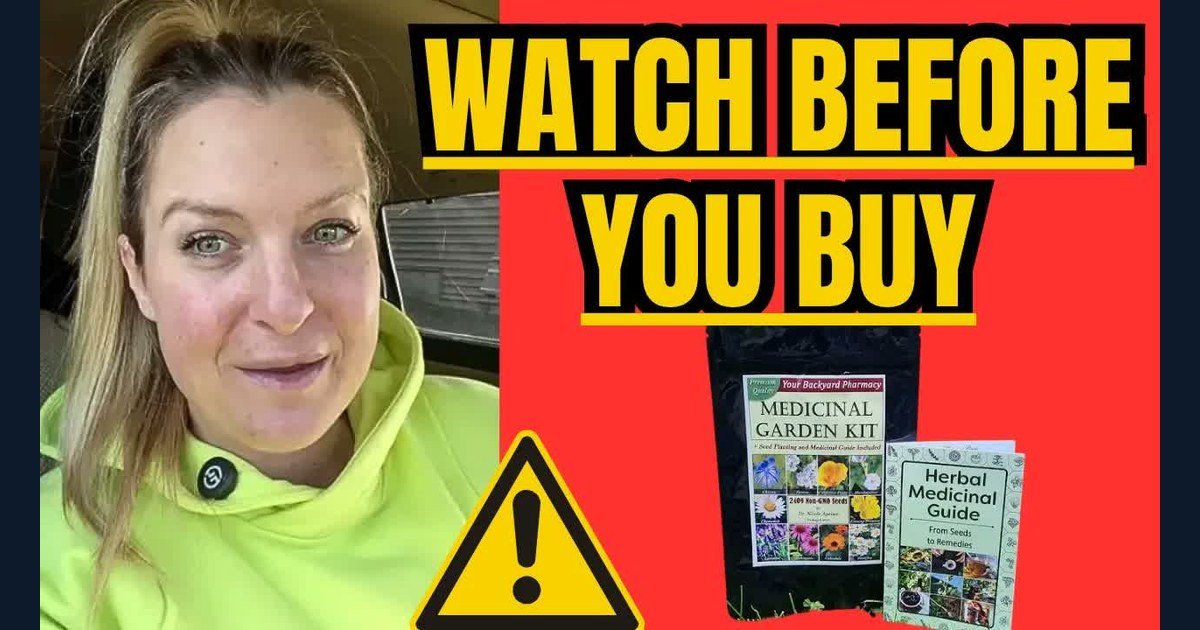
Nearly every product covered on this site is fronted by a voice with no face attached to it. This one is the exception, and the difference shows before you reach a single seed packet: the woman behind it has a history you can pull up and read for yourself.
Nicole Apelian trained as a biologist at McGill, teaches wilderness survival, and practises as a herbalist. She spent years living beside one of the oldest peoples on earth in the Kalahari, and in 2015 she lasted fifty-seven days alone in the wild for the History Channel's Alone. She also lives with multiple sclerosis, and speaks plainly about the climb from a wheelchair back to walking. You are not asked to believe any of it on her word - it is public record, and ten minutes of searching confirms it.
In an aisle that runs almost entirely on faceless narrators and life stories nobody can check, a name that survives a search is not a minor detail. It moves the starting line.
Unpacking the box
- Ten separate seed packets - 4,818 non-GMO seeds in total, packaged in the US
- Herbal Medicinal Guide: From Seeds to Remedies - the manual covering how to grow each plant and how to turn it into tinctures, ointments, salves, poultices, decoctions, infusions and oils
- Two bonus guides, each listed at $29
- 24/7 one-to-one support
- A 365-day money-back guarantee
The ten include chicory, which Apelian singles out as the pain-relieving plant Native Americans valued above any other; yarrow for wounds; the steadying pair of chamomile and lavender; and others reaching from liver support to a better night's sleep. Most are perennials, which is the quiet detail that matters: sow them once and they come up again each year on their own, turning a one-time box into a patch of ground that keeps giving.
The scene that carries the pitch - and earns its keep
Deep into Alone, on day forty-two, she tore her hand open gutting a fish, with no antibiotics within reach. She found yarrow, pressed it into the wound, and the bleeding stopped.
Weigh what that is: a named woman, a filmed show, a specific day - not "Sarah in Ohio" in a comment box. Whatever verdict you reach on the kit, that is a different order of evidence from the testimonials this category usually trades in.
A full year to decide - and why the calendar, not kindness, explains it
At 365 days, this is by some distance the longest refund window on the whole site, and the obvious reading is a seller sure of the product.
There is some of that in it, but the real work is being done by the seasons, and it favours you. Seeds sit inert until they are planted. Put them down in October and nothing stirs before spring. A window any shorter than a growing season would be worthless to half the people who buy in, forced to decide before a single packet had gone into the soil. The year is not a flourish - it is the shortest window a seed product could offer and still be straight with you, and they chose it over the usual sixty days.
The work the marketing leaves out - packet to remedy
This part deserves saying in plain terms, precisely because the sales copy does not.
Seeds are not medicine. Between the packet and anything you would actually use lie germination, a season of growth, a harvest, drying, and then the making itself - and none of it happens on its own. A tincture is weeks of patient steeping; a salve is a small process with steps. The manual walks you through all of it, but a process described on a page is not a process your hands have done.
So the honest question is not whether these plants are useful - they are. It is whether you are, in truth, someone who gardens. If you already grow things, this is ten new species and a solid reference book. If you have never once kept a pot going, it is a project with a stack of unfamiliar skills sitting in front of any reward - and the year-long guarantee exists, in part, because that stumble is real and common.
The savings, kept honest
The page reaches for a number - the $1,742 the average American spends at the pharmacy each year - and pitches the garden as a way to take a chunk of that back. Where the saving genuinely turns up is in the small and the repeated: the cup of chamomile instead of a sleep aid, the homemade salve for a graze, the remedy that costs nothing because it is growing a few steps from the door. Small each time, but it stacks up for as long as the perennials keep returning - which is the entire point of a garden that plants itself.
Where it stands apart
- a real, searchable expert instead of a narrator with no name
- 4,818 non-GMO seeds across ten mostly-perennial plants, packed in the US
- a manual that teaches the remedy-making, not only the planting
- 365 days of cover - the one window here that outlasts a growing season
What the pitch keeps quiet
- the real price only appears at the checkout, a click in
- this is gardening - germination, a season and a harvest come before any remedy
- buy in spring and you are off; buy in autumn and you wait on the soil
Questions buyers ask first
What turns up on the doorstep?
Ten seed packets - 4,818 seeds all told - together with the Herbal Medicinal Guide: From Seeds to Remedies, two bonus guides and around-the-clock support.
Am I resowing every spring?
Mostly no. The bulk of the ten are perennials and return after the first year without being replanted.
Do I have to know how to garden?
The manual assumes no experience and takes each plant through planting, growing and harvesting. The one thing no book supplies is the habit of minding something across a whole season.
What is the price?
The official page prints no figure - it shows at the checkout. What is stated is the year-long guarantee and the two bonuses at $29 each.
Are these plants safe to use?
They are herbs, not prescriptions, and they interact with medication as any active does. Anything you mean to take regularly is worth raising with a doctor, particularly on top of existing treatment.
How long is the refund window?
365 days, money back - long enough to see out a full growing season, which is exactly the point.
Is the Medicinal Garden Kit a scam?
No. Genuine seeds and a genuine manual from a named biologist and herbalist with a public record, sold through the official website with a year behind it.
What do the unhappy reviews tend to be about?
Planting at the wrong point in the year, or realising gardening is not for them. Twelve months of cover absorbs both.
Is this one for your plot?
Of everything reviewed here, the Medicinal Garden Kit is the simplest thing to buy and the one that fits in least with the rest. Nothing about it asks for faith in a hidden mechanism: seeds arrive, plants grow, and a book explains what to do with them. The person selling it is real and checkable, the seed count is exact, most of the plants return unbidden, and the year of cover is the only guarantee on the site that actually matches the thing it protects.
The single honest condition is that you are buying a garden, not a delivery. If you already grow things, these are ten species you will very likely be glad to keep. If you do not, buy in spring rather than autumn, get the packets into the ground inside the first fortnight while the intent is still fresh, and remember the refund runs a whole year - long enough that one failed sowing is not the end of the story.
If the broader draw is self-reliance, the builds in our Water Freedom System and Smart Water Box reviews take on the water side of the same instinct.
Ready to check current pricing and availability?
Official site · Current offer and refund policy shown there
This review is for informational purposes only and is not medical advice. This product is not intended to diagnose, treat, cure or prevent any disease. Individual results may vary.
Related reviews
Other products in Survival & Preparedness people compare this one with.

Energy Revolution System Review
The Tesla history it opens with is broadly accurate - and the weekend build sitting underneath it is a real independent power source for about $112 all in.
Read the review
Water Freedom System Review
A farmer who lived through the drought sells the blueprint he built to get out of it - a device that pulls drinking water from thin air, with 60 days to read the whole thing.
Read the review
Smart Water Box Review
Every other water build here is bolted to one address. This one fits in a car boot - and the author tells you what the parts actually cost.
Read the review
Kinzeno Review
The science under the microbubble gel, its complete ingredient list, the way the massage should be performed, the 60-day return terms and which pages carry the 70% deal.
Read the review